

We invited artist and editor José Ruiz Díaz to review the exhibition "Aunque es de noche" by artist David Felipe Escobar at Sketch Gallery in Bogotá (Nov 2024 – Feb 2025), notes on the boundaries between the possible and the impossible through the lens of desire.
When artist/filmmaker Jack Smith finished the film Flaming Creatures in 1963, many New York theaters refused to show it. During an exhibition organized by Jonas Mekas, police raided the venue, confiscated the tapes and projection equipment, and initiated legal proceedings against the event organizers, accusing them of violating morality. In defense of what happened, Susan Sontag wrote:
The only drawback to the detailed shots of flaccid penises and perky breasts, the scenes of masturbation and oral sex in Jack Smith's Flaming Creatures, is that we find it difficult to simply talk about this remarkable film: we feel compelled to defend it (…). Naturally, Flaming Creatures outrages, and it aims to do so.
This film is one of the most emblematic projects of queer cinema from the 1960s, and one that underpins many of today's imaginings of homoerotic representation. Other later films, such as James Bidgood's Pink Narcissus, proposed new visual languages to represent a male body oscillating between pleasure and pain. During this period, a color palette was consolidated, a prototype of the male body associated with desire and an aesthetic sensibility linked to the term camp, which Sontag defined as a love of the unnatural, the artificial, and exaggeration.
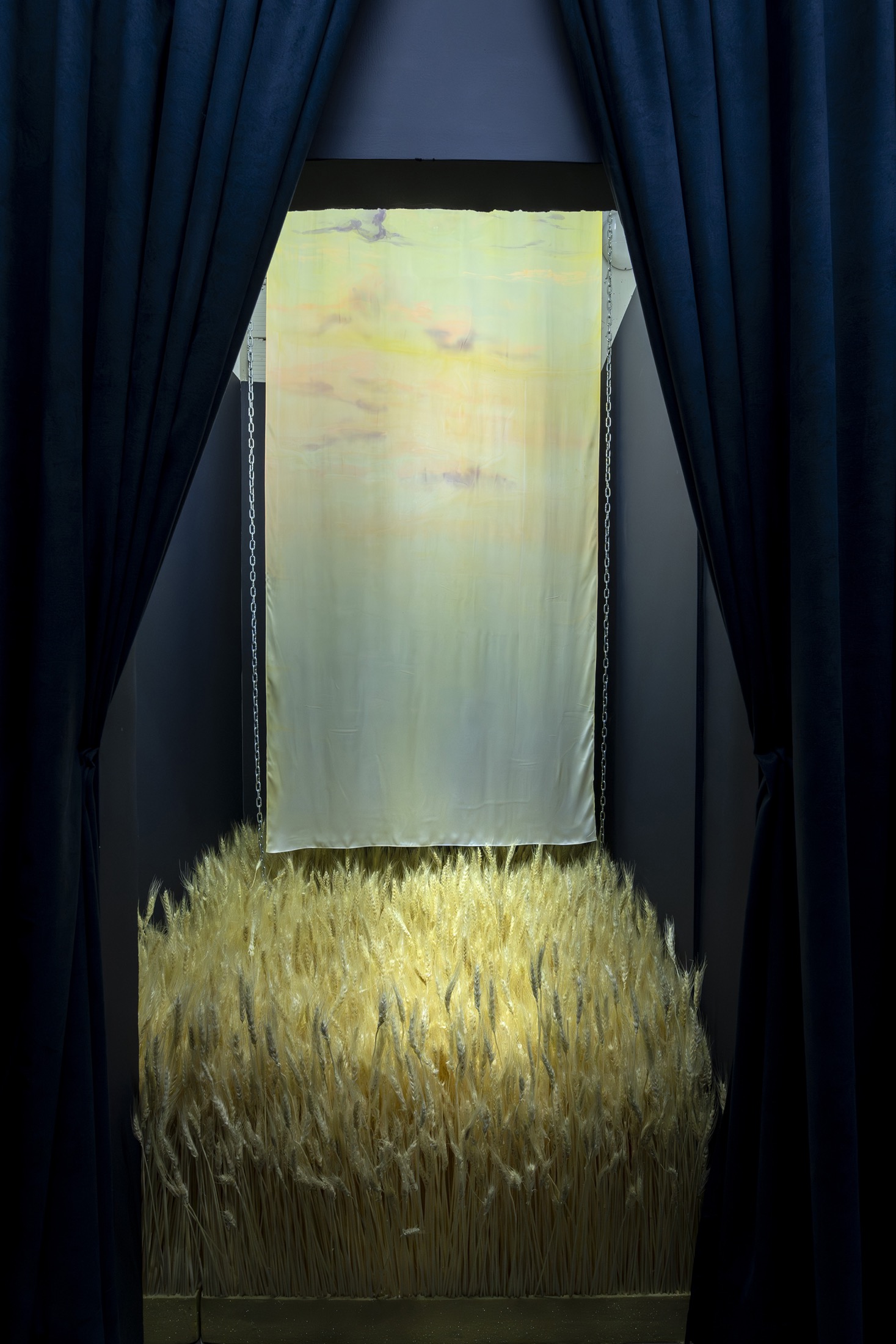
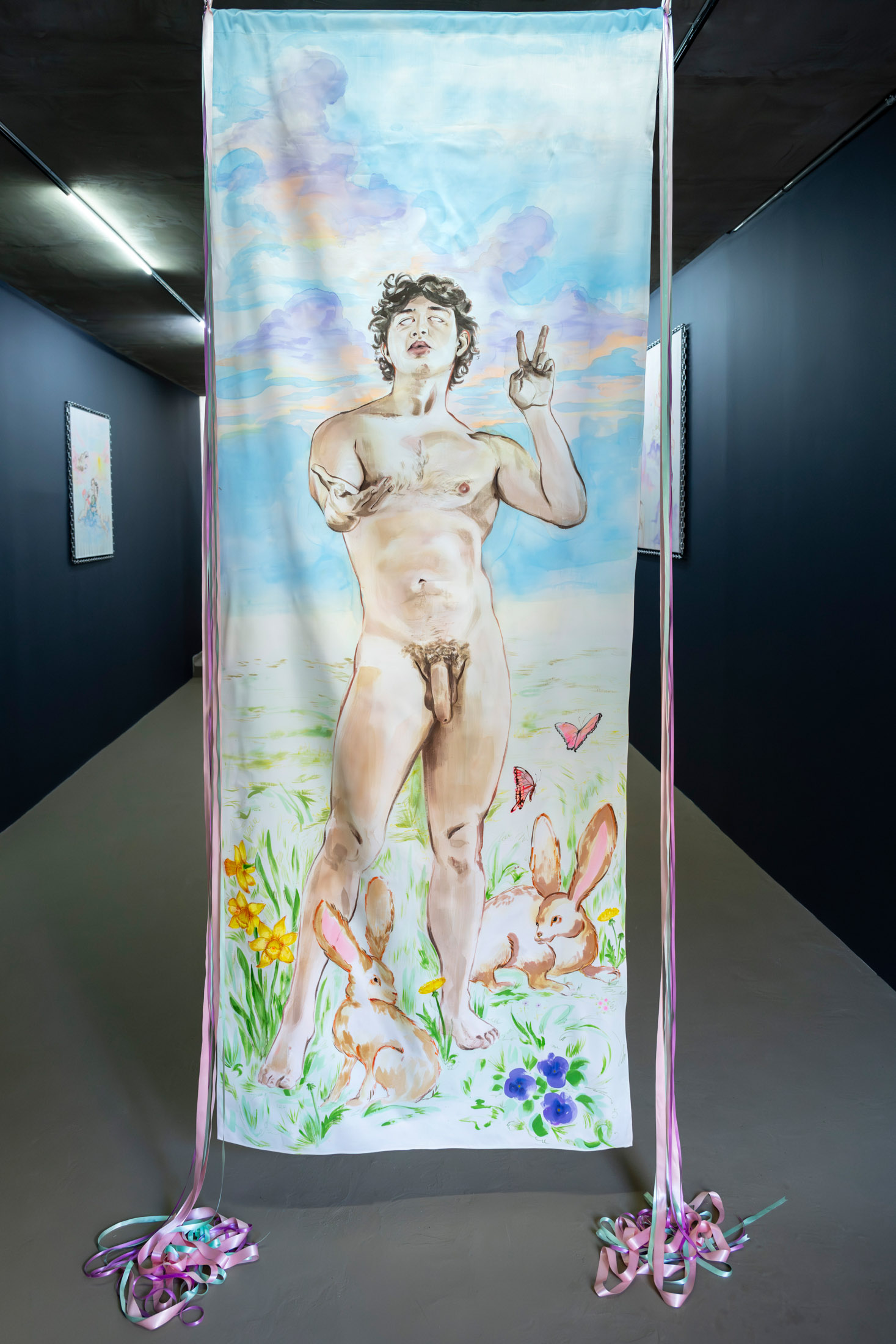
The exhibition Aunque es de noche [Although It Is Night] by David Felipe Escobar, at the Sketch gallery in Bogota (Nov 2024 to Feb 2025), is the heir to this imaginary. The rooms the artist built with dark blue velvet curtains and floors filled with ears of wheat are an extension of the rooms the protagonist of Pink Narcissus transits between sexual encounters and lucid dreams in a homoerotic paradise. The situations that this man experiences and imagines took place in the paintings hanging in the rooms of the gallery. The rabbits are found in these paintings and are reproduced in the film. In a paradise where the sky always has a pastel hue, men turned into satyrs kiss and masturbate.
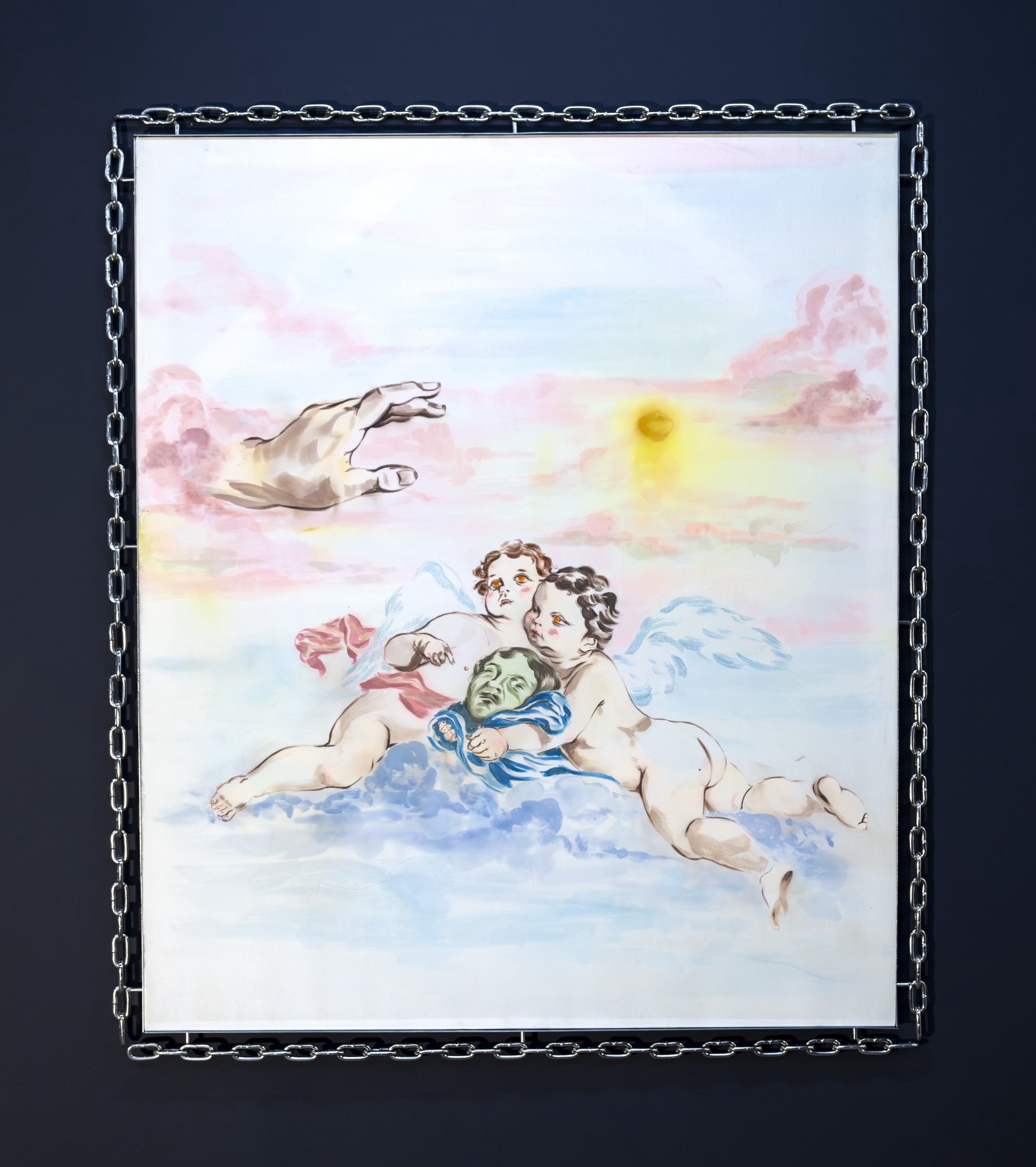
Mentioning the term camp to refer to an exhibition with vases on the floor, ears of wheat as mats, and where the paintings are framed with chains, can be understood as a common place lacking depth, even more so when the term has been used as a form of stigmatization: that which, due to its exaggeration, is rendered banal. However, the title of the exhibition refers—fortuitously— to the novel The World in the Evening, by Christopher Isherwood, where one of the first definitions of this concept is constructed. The night we inhabit in the company of other bodies, according to Isherwood's words, in response to David's paintings, is a moment of emotional excitement; it is a night of illuminating darkness, and for this very reason, the viewer wanders around the gallery with their head up, gazing into a heavenly paradise.
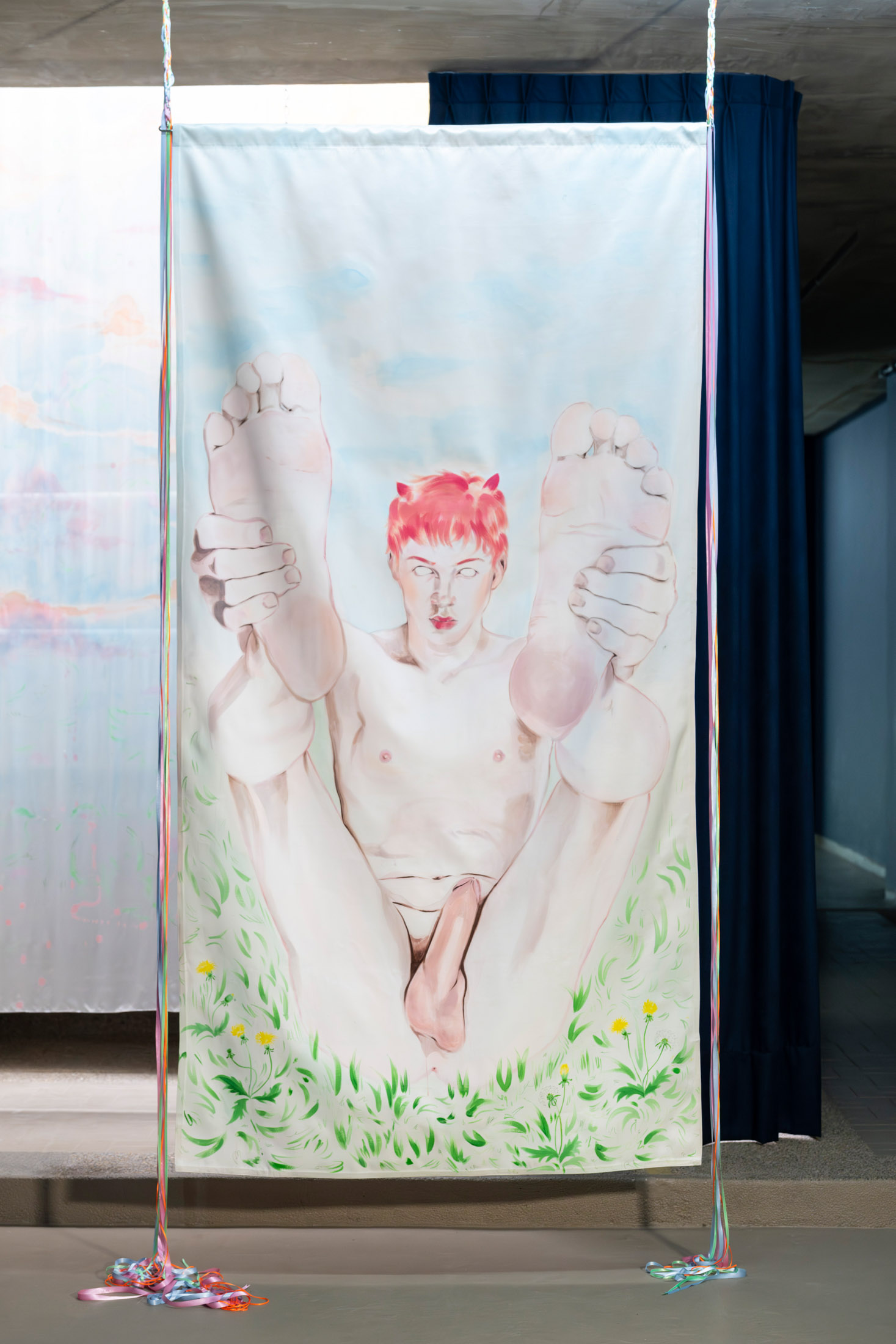
The body that greets the viewer upon entering the gallery—a naked man in a garden—belongs to a long tradition of homoerotic representation. This Saint Sebastian, freed from the tree trunk to which he was tied to receive his punishment, demonstrates the artist's visual repertoire and the links between his work and religious imagery. The image of Saint Sebastian is a symbol of aggression and desire: a subject shoots an arrow at a tied-up man; the aggressor's gaze, like the weapon, penetrates the body, desiring it. This ambiguity in the representation of the male body has a strong historical burden, as writer Ronald Key points out:
A Christian saint invoked against disease throughout the medieval period, a symbol of the exquisite, beardless youth of Apollonian beauty in the Renaissance, an example of the 'decadent' androgyny of the 19th century, and the emblem of homosexual consciousness in the 20th century, Saint Sebastian has, today, maintained his role as a distinctive 'perverse' martyr. Due in part to the medicalization of homosexuality as a distinctively feminizing disease in the fin-de-siècle, Sebastian has come to represent the formation and self-formation of the modern male homosexual. By refusing to take his place with the outdated icons of earlier eras, he has enhanced his position as the single most successful image of modern gay male identity.
In Colombia, the image of Saint Sebastian has been a recurring feature in the work of many artists. In 1998, the La Oficina gallery in Medellin organized the exhibition San Sebastian en Colombia hoy [Saint Sebastian in Colombia Today] featuring the work of 28 artists who interpreted the icon through suffering. In this collection, the emphasis was on corporal violence understood as a symbol of personal and collective oppression. David's work, while conscious of this violence, is inscribed in another moment of martyrdom, when the subject frees himself from bodily burdens and surrenders to enjoyment. In a broader sense, this can be understood as a shift in audience receptivity to queer representations. Although violence against non-normative bodies and subjectivities persists, power institutions no longer have the authority to raid and censor films or exhibitions.
In the words of Luisebastian Sanabria, Aunque es de noche is “a pictorial installation that, with the tension of chains, recalls the places where seduction and punishment took place.” The installation nature of the project demonstrates the artist's intention to construct a stage (surrounded by blue curtains) from which he can consider other forms of masculine representation emancipated from the regulatory society, although inscribed within an inherited visual system. Indeed, the pictorial installation was transformed overnight into a stage for the naked men in the paintings to interact with the public, guided by the sound of a harp, and the earthly world was transformed into the heavenly paradise that the artist dreams of as the protagonist of Pink Narcissus.
This staging, as in theater or film, responds to a desire to imagine other possible worlds, an intention shared by the vast majority of current projects made from queer perspectives. These other worlds—proposed from Colombia—occur during the Danza subversiva [Subversive dance] meetings organized by House of Yeguazas at Espacio Odeon, materialize in the first issue of the magazine Anales del museo Q [Annals of the Q Museum], regarding the dialogues between non-normative bodies within culture, and take us Al final del mundo [To the end of the world] with the proposal that Maria Isabel Rueda presented at the XI Luis Caballero Award (2022). I conclude this text with a quote from the Colombian philosopher Laura Quintana, in Politicas de los cuerpos [Body politics], a theoretical book on the bodily transformations produced by emancipatory practices:
These are then fractures that separate bodies from the behavior attributed to them by class, gender or, in general, by social identity assignments (...). Aesthetic heterotopias that involve reconfigurations of corporality in its interactions, allowing for the development of other ways of being, feeling, and speaking; other ways of interacting with others; "other spaces and positions than those attributed and naturalized"; and with this, also forms of experience that open up the realm of the possible, problematizing the rigid boundaries between the possible and the impossible in police logic.
[Exhibition documentation by Niko Jacob, courtesy of the gallery]



When artist/filmmaker Jack Smith finished the film Flaming Creatures in 1963, many New York theaters refused to show it. During an exhibition organized by Jonas Mekas, police raided the venue, confiscated the tapes and projection equipment, and initiated legal proceedings against the event organizers, accusing them of violating morality. In defense of what happened, Susan Sontag wrote:
The only drawback to the detailed shots of flaccid penises and perky breasts, the scenes of masturbation and oral sex in Jack Smith's Flaming Creatures, is that we find it difficult to simply talk about this remarkable film: we feel compelled to defend it (…). Naturally, Flaming Creatures outrages, and it aims to do so.
This film is one of the most emblematic projects of queer cinema from the 1960s, and one that underpins many of today's imaginings of homoerotic representation. Other later films, such as James Bidgood's Pink Narcissus, proposed new visual languages to represent a male body oscillating between pleasure and pain. During this period, a color palette was consolidated, a prototype of the male body associated with desire and an aesthetic sensibility linked to the term camp, which Sontag defined as a love of the unnatural, the artificial, and exaggeration.
The exhibition Aunque es de noche [Although It Is Night] by David Felipe Escobar, at the Sketch gallery in Bogota (Nov 2024 to Feb 2025), is the heir to this imaginary. The rooms the artist built with dark blue velvet curtains and floors filled with ears of wheat are an extension of the rooms the protagonist of Pink Narcissus transits between sexual encounters and lucid dreams in a homoerotic paradise. The situations that this man experiences and imagines took place in the paintings hanging in the rooms of the gallery. The rabbits are found in these paintings and are reproduced in the film. In a paradise where the sky always has a pastel hue, men turned into satyrs kiss and masturbate.
Mentioning the term camp to refer to an exhibition with vases on the floor, ears of wheat as mats, and where the paintings are framed with chains, can be understood as a common place lacking depth, even more so when the term has been used as a form of stigmatization: that which, due to its exaggeration, is rendered banal. However, the title of the exhibition refers—fortuitously— to the novel The World in the Evening, by Christopher Isherwood, where one of the first definitions of this concept is constructed. The night we inhabit in the company of other bodies, according to Isherwood's words, in response to David's paintings, is a moment of emotional excitement; it is a night of illuminating darkness, and for this very reason, the viewer wanders around the gallery with their head up, gazing into a heavenly paradise.
The body that greets the viewer upon entering the gallery—a naked man in a garden—belongs to a long tradition of homoerotic representation. This Saint Sebastian, freed from the tree trunk to which he was tied to receive his punishment, demonstrates the artist's visual repertoire and the links between his work and religious imagery. The image of Saint Sebastian is a symbol of aggression and desire: a subject shoots an arrow at a tied-up man; the aggressor's gaze, like the weapon, penetrates the body, desiring it. This ambiguity in the representation of the male body has a strong historical burden, as writer Ronald Key points out:
A Christian saint invoked against disease throughout the medieval period, a symbol of the exquisite, beardless youth of Apollonian beauty in the Renaissance, an example of the 'decadent' androgyny of the 19th century, and the emblem of homosexual consciousness in the 20th century, Saint Sebastian has, today, maintained his role as a distinctive 'perverse' martyr. Due in part to the medicalization of homosexuality as a distinctively feminizing disease in the fin-de-siècle, Sebastian has come to represent the formation and self-formation of the modern male homosexual. By refusing to take his place with the outdated icons of earlier eras, he has enhanced his position as the single most successful image of modern gay male identity.
In Colombia, the image of Saint Sebastian has been a recurring feature in the work of many artists. In 1998, the La Oficina gallery in Medellin organized the exhibition San Sebastian en Colombia hoy [Saint Sebastian in Colombia Today] featuring the work of 28 artists who interpreted the icon through suffering. In this collection, the emphasis was on corporal violence understood as a symbol of personal and collective oppression. David's work, while conscious of this violence, is inscribed in another moment of martyrdom, when the subject frees himself from bodily burdens and surrenders to enjoyment. In a broader sense, this can be understood as a shift in audience receptivity to queer representations. Although violence against non-normative bodies and subjectivities persists, power institutions no longer have the authority to raid and censor films or exhibitions.
In the words of Luisebastian Sanabria, Aunque es de noche is “a pictorial installation that, with the tension of chains, recalls the places where seduction and punishment took place.” The installation nature of the project demonstrates the artist's intention to construct a stage (surrounded by blue curtains) from which he can consider other forms of masculine representation emancipated from the regulatory society, although inscribed within an inherited visual system. Indeed, the pictorial installation was transformed overnight into a stage for the naked men in the paintings to interact with the public, guided by the sound of a harp, and the earthly world was transformed into the heavenly paradise that the artist dreams of as the protagonist of Pink Narcissus.
This staging, as in theater or film, responds to a desire to imagine other possible worlds, an intention shared by the vast majority of current projects made from queer perspectives. These other worlds—proposed from Colombia—occur during the Danza subversiva [Subversive dance] meetings organized by House of Yeguazas at Espacio Odeon, materialize in the first issue of the magazine Anales del museo Q [Annals of the Q Museum], regarding the dialogues between non-normative bodies within culture, and take us Al final del mundo [To the end of the world] with the proposal that Maria Isabel Rueda presented at the XI Luis Caballero Award (2022). I conclude this text with a quote from the Colombian philosopher Laura Quintana, in Politicas de los cuerpos [Body politics], a theoretical book on the bodily transformations produced by emancipatory practices:
These are then fractures that separate bodies from the behavior attributed to them by class, gender or, in general, by social identity assignments (...). Aesthetic heterotopias that involve reconfigurations of corporality in its interactions, allowing for the development of other ways of being, feeling, and speaking; other ways of interacting with others; "other spaces and positions than those attributed and naturalized"; and with this, also forms of experience that open up the realm of the possible, problematizing the rigid boundaries between the possible and the impossible in police logic.
[Exhibition documentation by Niko Jacob, courtesy of the gallery]


Subscribe to our newsletter!
¡Gracias por suscribirte!











CALLE DEL ARTÍCULO 123 #116 INT. 100,
COLONIA CENTRO, CUAUHTÉMOC,
CDMX 06040, MÉXICO