What does it mean today to conjugate the idea of humanity? The 36th São Paulo Biennial sought to articulate this question through beauty, ritual, music, and architecture, but also through frictions, ambiguities, and conceptual disputes. Art critic Tatiane de Assis proposes a profound exercise in reflection amid the banalization of criticism, the commodification of opinion, and identity performance.
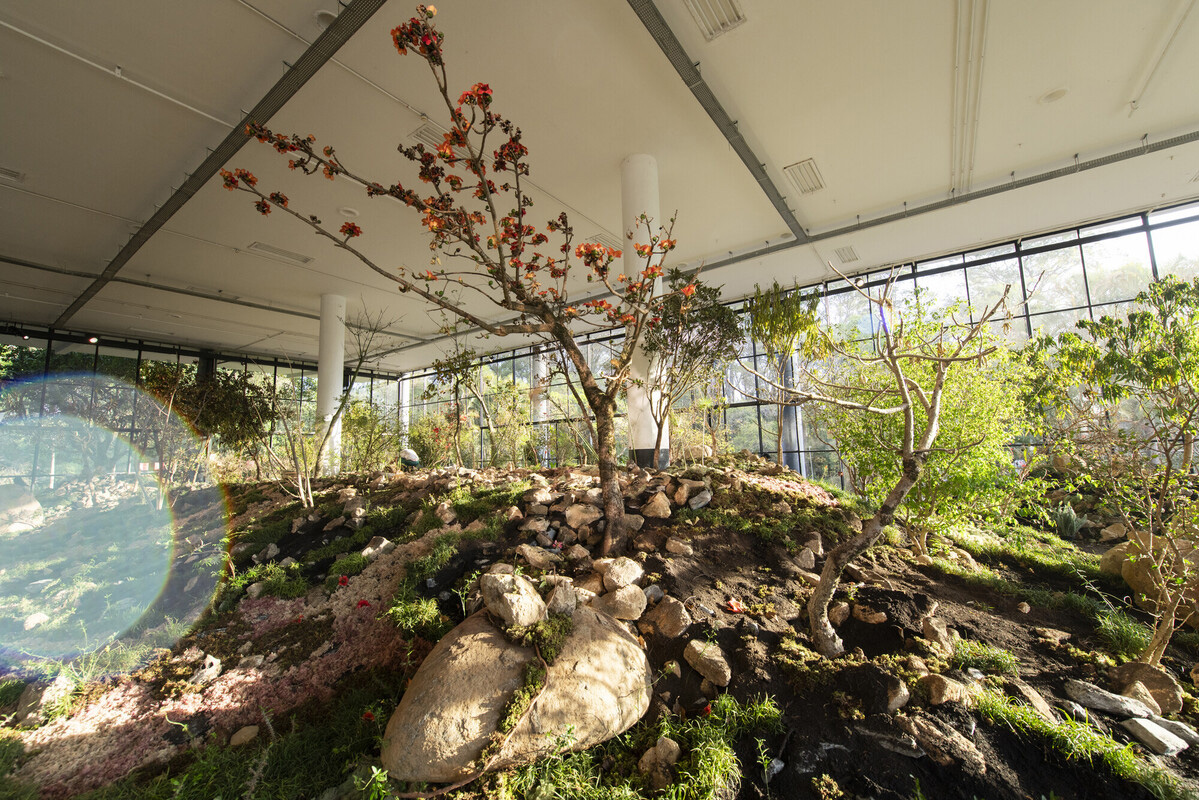
And I’ll spend some time on Okoyomon’s installation Sun of Consciousness. God Blow Thru Me – Love Break Me (2025), which, according to the curatorial text, engages in a dialogue with the Brazilian biome known as the Cerrado, evoking its symbiotic and unpredictable relations born from multiple encounters. The artwork also invites us to imagine collective spaces for rest, and to sense how such gestures might shape the audience’s experience within the exhibition.
The list of curatorial intentions is not fully achieved. Okoyomon’s installation remains ambiguous. With its jets of white smoke, it has a somewhat island-like or alien garden quality, transplanted inside the Bienal pavilion. On the one hand, it certainly establishes a new rhythm for walking and contemplation. At the end of the path, one might sense a certain serenity. On the other hand, it’s just a passageway for many who seek to reach the top of the trail and glimpse the pavilion from above, from another perspective beyond the ground level.
During one of my visits to the exhibition, next to the pond at the end of the little path created inside the art work, I observed how a little girl of ten, or younger, crouched down and stared for several minutes at the bottom of the shallow mirror of water. I imagined what she was trying to see, perhaps nothing—I thought—as the scene reminded me of Ailton Krenak, who in one of his books argues that “life is not useful.” However, playing devil’s advocate, I also thought that coexisting with nature, from a stance of alterity, is not a piece of cake. Thus, I believe that the terms of the dialogue between humanity and nature are the central issue of Precious’s art work. In the eagerness to distance ourselves from extractivist models, we resort to modes that speak to the romanticization of this relationship.
In this sense, it is important to listen to Krenak again, who in a video presented at an exhibition in his honor at Itaú Cultural, makes an intriguing reflection:
“Whoever is within this extractivist worldview will not be affected by a poetics of the earth. But whoever preserves, in some way, any minimal inheritance from Mother Earth will make that return, so to speak, to the earth, like returning home, a coming back in peace in a troubled world. I have no doubt that we are inhabiting a planet in crisis, in a global sense. Inviting people to turn to the earth, to learn from the earth, is a kind of mantra, with no certainty that it will have any effect.”
Back to the installation, it may feel weird. Although there is soil—but not the red kind, native to the Cerrado—mango and Surinam cherry trees next to a pond, the glass windows of the building surrounding the installation, which overlook the real trees in Ibirapuera Park, convey a sense of detachment from nature.
This encounter between modern architecture and the Cerrado may even evoke Brasília, the federal capital imposed upon both the Planalto Central’s nature and its indigenous and quilombola communities. The city is also immerse in so many contradictions: yes, it provides daily contact with nature, but it is also intensely violent in selecting who can enjoy it.
Keeping the encounter of modern architecture and the Cerrado in mind, our attention then focuses on the modernist volume—located in the very same floor—that shapes the Biennial building in contrast with an adobe curved wall—part of the installation by the group Sertão Negro, from Goiânia, another planned city in the Brazilian Midwest.
Still within the exhibition’s opening gesture, it’s worth discussing Battle of Cam, by Gê Viana.
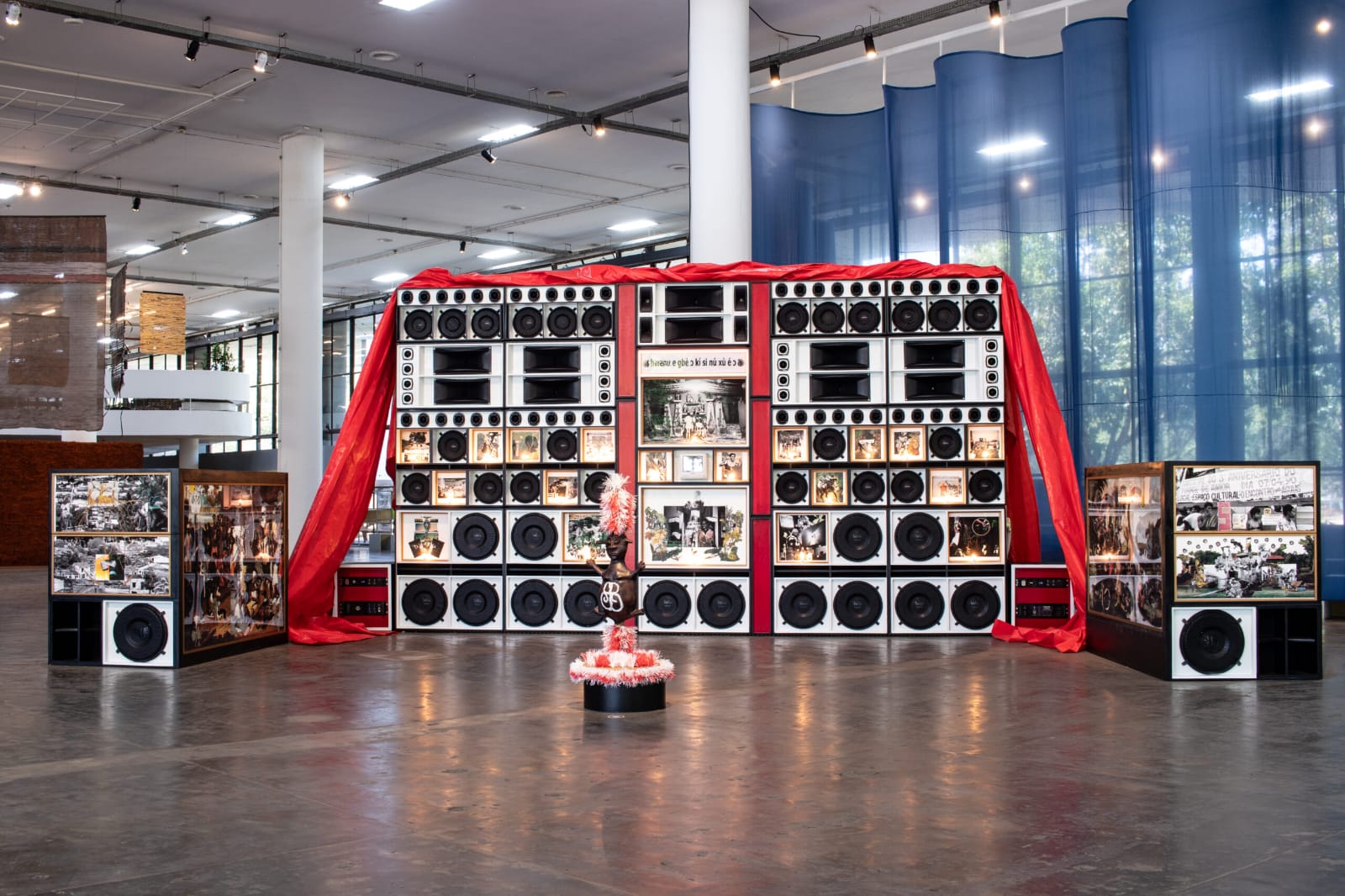
The sound system’s music envelops visitors who sway or tap their feet to the rhythm of reggae, even before they know what the work is about. Here, the exhibition more generally already signals that it aims to engage with musical language and seeks a visitor flow that departs far from the white cube, resembling more a music festival or a concert in a park. But this only comes as a hint, and one must walk further to better understand the proposition.
In the collages affixed to Gê’s sound boxes, you can see news reports about the prohibition of Maranhão reggae—a musical style born from the African diaspora—and of Tambor de Mina—a cultural manifestation and religion rooted in the traditions of enslaved Black people. Such a flow that begins in blood and death, originated in a diaspora, manifests itself through music, art, architecture, and ornament—as thinkers Paul Gilroy and Anne Lafont remind us.
And if the conjunction of resistance and celebration seems strange, we can understand it better by turning to the book The Delusions of Care by the Biennial’s chief curator, Bonaventure Soh Bejeng Ndikung, who says: “To strike back is to have hope, and to have hope is to be able to react.”
Viana’s work also evokes an altar composed of small lights, reminiscent of candles. In that vein, the space bounded by the frontal sculpture and the sound system thus becomes a place for a ceremony that is celebrated by dancing. The motto of this terreiro is written in tiny letters among the speakers. Only few people notice, since it is in Fon, the language used in Tambor de Mina. Yet if you ask Gê, she will translate: “When the sound has come to kiss the sea.”
After the last decade of intense debate in Brazil about race in the visual arts, it seems abrupt that the curatorial team chose “conjugating humanity” as a guide for the collective show, because the term “humanity” has been used to justify universalism, among other claims.
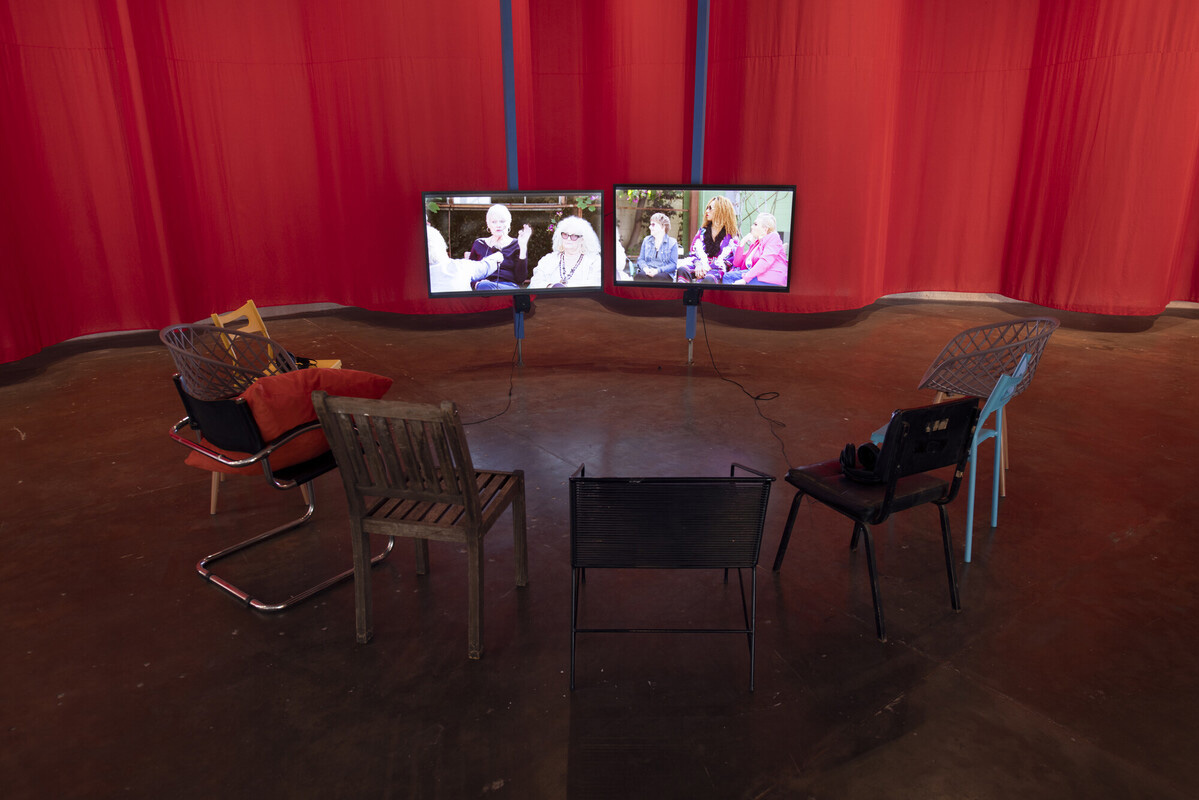
The closest I've come to understanding this curatorial proposal is through an extraordinary series of videos called Richerche by Sharon Heyes, in which the stereotypes are dismantled, one by one, until a fabric of shared feelings emerges—despite race and class, yet without erasing them. In Hayes’s work, humanity surfaces without the pacifying tone of “we are all the same,” but also without surrendering to the idea that the individual is strictly determined by race, class, or gender.
Hayes’s works, much like those of Frank Bowling, are recurrent throughout the exhibition, almost like a chorus. This return seems to reinforce the understanding of humanity that the exhibition proposes. And rather than searching for a new term to name this, the choice to retain the word humanity insists instead on disputing the meaning of the word itself, as the chief curator, Bonaventure, emphasized on October 28th at Sesc Pompeia.
There is another possible hypothesis for understanding why the curators chose to frame the exhibition through the idea of a “conjugation of humanity”: while detractors expected Black figurative painting to dominate both the previous and the current edition of the Biennial, Black curators chose—by conviction and by strategy—to pursue other paths.
Albeit not stated explicitly, to me one of the drivers of the shift is an effort to reconfigure the terms through which Black artists are recognized and, thus, as mentioned earlier, to contest the concept of humanity itself. Why is multiplicity permitted to some, but not to others? Furthermore, if the art world claims exhaustion with artistic production tied to “identity politics,” is the system truly open to discussing a new idea of humanity?
In this sense, it is striking that this edition takes “beauty” as a fundamental principle—a statement made by the chief curator and his team in the sixth and final chapter of the exhibition. Beauty as resistance, and as a tool to engage and bring people closer to the questions the show raises.
Accordingly, the audience may not fully grasp the meaning of the Gameleira tree in Afro-Brazilian religions.
Yet the visitors are still drawn to the strands of yellow beads that fall gently from the trunk of the sacred Gameleira tree she presents. The symbolic meaning of the gourd may also go unnoticed, though one can sense its importance through the care with which it is passed from bird-woman to bird-woman—the sculptures around the tree. Curiously, such pieces here play a role similar to that of monuments—except this time, they do not speak for Western hegemony, but for Yoruba culture.
Laurie Provost’s flower evokes a similar response—showing that beauty and wonder can be tools for connection, a way to open conversation. The first reaction is a soft “ohh,” followed by questions: “What are those spheres inside?” and “Are these real plants?” At that moment, the textile matters, the movement matters—but scale matters too, a strategy Ndikung also adopted to start a conversation with the imposing (in its own way) pavilion design by Oscar Niemeyer.
In this edition, a logic of vertically scaled occupation of the pavilion seems to be at play: it also appears in the works of Ana Raylander Mártir dos Anjos, in Tanka Fonta’s piece (in the axis surrounding the ramp), and in Otobong Nkanga’s tapestries, which punctuate each level.
A group of three works located on the second floor could also be added to this discussion of beauty, even though the chapter there is titled “Flows of Care and Plural Cosmologies.”
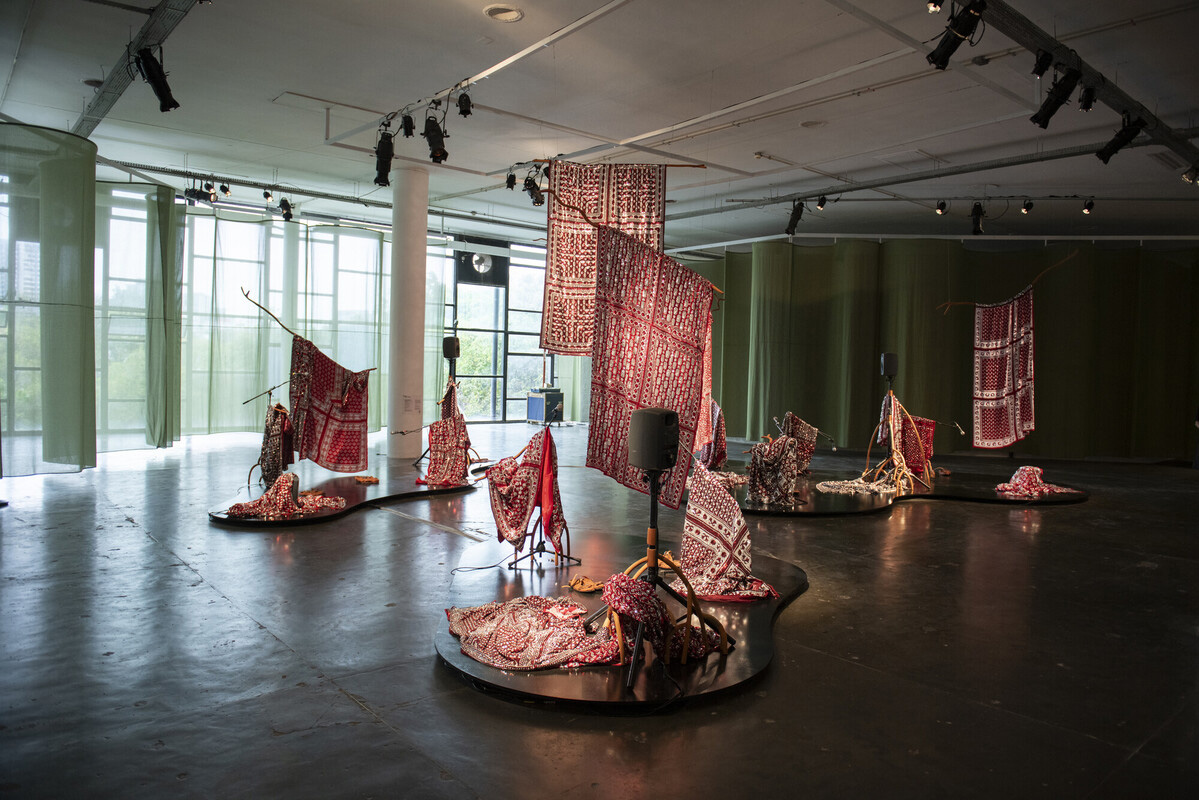
Ten years ago, Miriam Omar Awad’s installation, titled The smell of earth after the fire and the promise of breathing spaces: through the obsession with resonance tenderly spreading our skin / Our bodies / From the incandescent heat of ashes, might have appeared in an anthropology-oriented group exhibition, given that the shiromani—traditional Comorian textiles—are ritual objects. But today, amid the ongoing rewriting of Art History, Awad’s work is presented differently.
Before any logical association forms, the luminous pieces suspended from the ceiling seize you visually, through their exuberant geometric compositions. Then, the microphones activate, and the connection with the artwork widens. Suddenly, you realize a conversation is taking place: through the textiles, the voices, and the spatial arrangement.
Miriam reconstructs a kind of scene that alludes to the Debe, a ritual tradition carried out by women in the Comoros Islands, on the eastern coast of the African continent, as a way of resolving conflict.
Nearby, Juliana dos Santos’s installation deserved a larger space—or at least one that would allow viewers to apprehend the ensemble as a whole. The same could be said of Lídia Lisboa’s work, positioned close by.
Juliana is a significant figure in the contemporary scene, not only because of the depth of her research but also due to the constancy and perseverance with which she advances her practice—despite the boom of figurative painting in the Brazilian art system. She began her research on the color blue in 2016, and in 2019 she presented one of her most important works at Paço das Artes, the installation Between the blue and what I don’t allow/am not allowed to forget.
One of the sources for her blue is the Clitoria ternatea flower, a plant cultivated by her grandmother. When she brings her grandmother into the work—and later we learn her mother as well—a crucial element of her practice becomes visible: collective gestures and experiences rooted in art education.
In Juliana’s large-scale watercolors, the unpredictable flow created by brushing the paper with water and then blowing pigment extracted from the flower—without knowing how far the color will run—forms spiraling landscapes that draw the viewer both from afar and up close. There is also a meditative quality that links her work, without dogma, to aspects of Buddhist practice.
Lídia Lisboa’s works move in another direction.
Beauty emerges through the juxtaposition of colors, the wide open crochet stitches, and the stretching forms of her sculptures—which she calls tetas (breasts). And once again, through the path of beauty, the notion of art expands. Now, with the growing appreciation for textiles, even the ever-familiar crochet is gaining recognition.
Finally, an unexpected encounter between the works of Maxwell Alexandre and Isa Genken.
Placing the two artists side by side is a provocation that brings a certain sense of humor to the exhibition. Although Maxwell’s works are made on brown kraft paper—an ordinary material—there is a kind of elegance in them, even when he’s criticizing the white cube. Isa’s work moves in the opposite direction and provokes extreme aversion. You look at it and think: “There’s no way she actually did this.” She doesn’t operate with the idea of beauty, enchantment, or even the notion of craftsmanship.
Beyond the works themselves, there was intense debate around the exhibition labels, which were not placed directly next to the artworks.
I understand that this gesture isn’t new—it is recurrent in Bonaventure’s exhibitions in Germany. However, in the Brazilian context, it felt more like noise, which disrupted the visitors’ experience and left many feeling disoriented.
This sensation emerges because many of the artists on view are not widely known to Brazilian audiences, and also because, in recent years, museums in the country have introduced more explanatory labels, to welcome and engage their audiences. In contrast, some galleries or other private art spaces, do not provide labels, thus making which little effort to engage with non-specialized audiences.
That said, I see it as experimental gesture from someone who thinks of the exhibition as a kind of jam session; however, in the Brazilian context—to use an art-world expression—it simply didn’t work.
Later on, it’s worth noting, the labels were placed closer to the pieces.
As for the colors used in the exhibition design, the strategy worked very well on the large wall where Márcia Falcão’s vibrant paintings are shown. However, when we consider Rebeca Carapiá’s sculptures—which unfold through their shadows, extending in every direction—unfortunately, the mustard-colored curtain almost covers the works. The same does not happen with the diaphanous green fabric, which merely hints at Gervane de Paula’s creatures.
In closing, it is pivotal to highlight the public program gives the exhibition a distinct character.
On my second visit, there was a Congada, and the crowd moved among the works, activating them in unexpected ways. The exhibition also transforms when there are many people—there’s an organic flow, rather than that usual tension of “don’t touch, it’s art.”
On the fourth visit—still thinking about this point—the programmed activity was the “Biennial in the Mangrove Festival,” featuring musicians from Pernambuco such as BUHR, Maciel Salú, and Mundo Livre S/A. Curiously, during the performance of the latter group, I noticed very few visual artists in the audience, which led me to speculate: beyond being conceived as an event that exceeds the mere display of artworks, the 36th São Paulo Biennial—with its hits and misses—genuinely bets on a non-specialized public. And that may disturb some people.
And I’ll spend some time on Okoyomon’s installation Sun of Consciousness. God Blow Thru Me – Love Break Me (2025), which, according to the curatorial text, engages in a dialogue with the Brazilian biome known as the Cerrado, evoking its symbiotic and unpredictable relations born from multiple encounters. The artwork also invites us to imagine collective spaces for rest, and to sense how such gestures might shape the audience’s experience within the exhibition.
The list of curatorial intentions is not fully achieved. Okoyomon’s installation remains ambiguous. With its jets of white smoke, it has a somewhat island-like or alien garden quality, transplanted inside the Bienal pavilion. On the one hand, it certainly establishes a new rhythm for walking and contemplation. At the end of the path, one might sense a certain serenity. On the other hand, it’s just a passageway for many who seek to reach the top of the trail and glimpse the pavilion from above, from another perspective beyond the ground level.
During one of my visits to the exhibition, next to the pond at the end of the little path created inside the art work, I observed how a little girl of ten, or younger, crouched down and stared for several minutes at the bottom of the shallow mirror of water. I imagined what she was trying to see, perhaps nothing—I thought—as the scene reminded me of Ailton Krenak, who in one of his books argues that “life is not useful.” However, playing devil’s advocate, I also thought that coexisting with nature, from a stance of alterity, is not a piece of cake. Thus, I believe that the terms of the dialogue between humanity and nature are the central issue of Precious’s art work. In the eagerness to distance ourselves from extractivist models, we resort to modes that speak to the romanticization of this relationship.
In this sense, it is important to listen to Krenak again, who in a video presented at an exhibition in his honor at Itaú Cultural, makes an intriguing reflection:
“Whoever is within this extractivist worldview will not be affected by a poetics of the earth. But whoever preserves, in some way, any minimal inheritance from Mother Earth will make that return, so to speak, to the earth, like returning home, a coming back in peace in a troubled world. I have no doubt that we are inhabiting a planet in crisis, in a global sense. Inviting people to turn to the earth, to learn from the earth, is a kind of mantra, with no certainty that it will have any effect.”
Back to the installation, it may feel weird. Although there is soil—but not the red kind, native to the Cerrado—mango and Surinam cherry trees next to a pond, the glass windows of the building surrounding the installation, which overlook the real trees in Ibirapuera Park, convey a sense of detachment from nature.
This encounter between modern architecture and the Cerrado may even evoke Brasília, the federal capital imposed upon both the Planalto Central’s nature and its indigenous and quilombola communities. The city is also immerse in so many contradictions: yes, it provides daily contact with nature, but it is also intensely violent in selecting who can enjoy it.
Keeping the encounter of modern architecture and the Cerrado in mind, our attention then focuses on the modernist volume—located in the very same floor—that shapes the Biennial building in contrast with an adobe curved wall—part of the installation by the group Sertão Negro, from Goiânia, another planned city in the Brazilian Midwest.
Still within the exhibition’s opening gesture, it’s worth discussing Battle of Cam, by Gê Viana.
The sound system’s music envelops visitors who sway or tap their feet to the rhythm of reggae, even before they know what the work is about. Here, the exhibition more generally already signals that it aims to engage with musical language and seeks a visitor flow that departs far from the white cube, resembling more a music festival or a concert in a park. But this only comes as a hint, and one must walk further to better understand the proposition.
In the collages affixed to Gê’s sound boxes, you can see news reports about the prohibition of Maranhão reggae—a musical style born from the African diaspora—and of Tambor de Mina—a cultural manifestation and religion rooted in the traditions of enslaved Black people. Such a flow that begins in blood and death, originated in a diaspora, manifests itself through music, art, architecture, and ornament—as thinkers Paul Gilroy and Anne Lafont remind us.
And if the conjunction of resistance and celebration seems strange, we can understand it better by turning to the book The Delusions of Care by the Biennial’s chief curator, Bonaventure Soh Bejeng Ndikung, who says: “To strike back is to have hope, and to have hope is to be able to react.”
Viana’s work also evokes an altar composed of small lights, reminiscent of candles. In that vein, the space bounded by the frontal sculpture and the sound system thus becomes a place for a ceremony that is celebrated by dancing. The motto of this terreiro is written in tiny letters among the speakers. Only few people notice, since it is in Fon, the language used in Tambor de Mina. Yet if you ask Gê, she will translate: “When the sound has come to kiss the sea.”
After the last decade of intense debate in Brazil about race in the visual arts, it seems abrupt that the curatorial team chose “conjugating humanity” as a guide for the collective show, because the term “humanity” has been used to justify universalism, among other claims.
The closest I've come to understanding this curatorial proposal is through an extraordinary series of videos called Richerche by Sharon Heyes, in which the stereotypes are dismantled, one by one, until a fabric of shared feelings emerges—despite race and class, yet without erasing them. In Hayes’s work, humanity surfaces without the pacifying tone of “we are all the same,” but also without surrendering to the idea that the individual is strictly determined by race, class, or gender.
Hayes’s works, much like those of Frank Bowling, are recurrent throughout the exhibition, almost like a chorus. This return seems to reinforce the understanding of humanity that the exhibition proposes. And rather than searching for a new term to name this, the choice to retain the word humanity insists instead on disputing the meaning of the word itself, as the chief curator, Bonaventure, emphasized on October 28th at Sesc Pompeia.
There is another possible hypothesis for understanding why the curators chose to frame the exhibition through the idea of a “conjugation of humanity”: while detractors expected Black figurative painting to dominate both the previous and the current edition of the Biennial, Black curators chose—by conviction and by strategy—to pursue other paths.
Albeit not stated explicitly, to me one of the drivers of the shift is an effort to reconfigure the terms through which Black artists are recognized and, thus, as mentioned earlier, to contest the concept of humanity itself. Why is multiplicity permitted to some, but not to others? Furthermore, if the art world claims exhaustion with artistic production tied to “identity politics,” is the system truly open to discussing a new idea of humanity?
In this sense, it is striking that this edition takes “beauty” as a fundamental principle—a statement made by the chief curator and his team in the sixth and final chapter of the exhibition. Beauty as resistance, and as a tool to engage and bring people closer to the questions the show raises.
Accordingly, the audience may not fully grasp the meaning of the Gameleira tree in Afro-Brazilian religions.
Yet the visitors are still drawn to the strands of yellow beads that fall gently from the trunk of the sacred Gameleira tree she presents. The symbolic meaning of the gourd may also go unnoticed, though one can sense its importance through the care with which it is passed from bird-woman to bird-woman—the sculptures around the tree. Curiously, such pieces here play a role similar to that of monuments—except this time, they do not speak for Western hegemony, but for Yoruba culture.
Laurie Provost’s flower evokes a similar response—showing that beauty and wonder can be tools for connection, a way to open conversation. The first reaction is a soft “ohh,” followed by questions: “What are those spheres inside?” and “Are these real plants?” At that moment, the textile matters, the movement matters—but scale matters too, a strategy Ndikung also adopted to start a conversation with the imposing (in its own way) pavilion design by Oscar Niemeyer.
In this edition, a logic of vertically scaled occupation of the pavilion seems to be at play: it also appears in the works of Ana Raylander Mártir dos Anjos, in Tanka Fonta’s piece (in the axis surrounding the ramp), and in Otobong Nkanga’s tapestries, which punctuate each level.
A group of three works located on the second floor could also be added to this discussion of beauty, even though the chapter there is titled “Flows of Care and Plural Cosmologies.”
Ten years ago, Miriam Omar Awad’s installation, titled The smell of earth after the fire and the promise of breathing spaces: through the obsession with resonance tenderly spreading our skin / Our bodies / From the incandescent heat of ashes, might have appeared in an anthropology-oriented group exhibition, given that the shiromani—traditional Comorian textiles—are ritual objects. But today, amid the ongoing rewriting of Art History, Awad’s work is presented differently.
Before any logical association forms, the luminous pieces suspended from the ceiling seize you visually, through their exuberant geometric compositions. Then, the microphones activate, and the connection with the artwork widens. Suddenly, you realize a conversation is taking place: through the textiles, the voices, and the spatial arrangement.
Miriam reconstructs a kind of scene that alludes to the Debe, a ritual tradition carried out by women in the Comoros Islands, on the eastern coast of the African continent, as a way of resolving conflict.
Nearby, Juliana dos Santos’s installation deserved a larger space—or at least one that would allow viewers to apprehend the ensemble as a whole. The same could be said of Lídia Lisboa’s work, positioned close by.
Juliana is a significant figure in the contemporary scene, not only because of the depth of her research but also due to the constancy and perseverance with which she advances her practice—despite the boom of figurative painting in the Brazilian art system. She began her research on the color blue in 2016, and in 2019 she presented one of her most important works at Paço das Artes, the installation Between the blue and what I don’t allow/am not allowed to forget.
One of the sources for her blue is the Clitoria ternatea flower, a plant cultivated by her grandmother. When she brings her grandmother into the work—and later we learn her mother as well—a crucial element of her practice becomes visible: collective gestures and experiences rooted in art education.
In Juliana’s large-scale watercolors, the unpredictable flow created by brushing the paper with water and then blowing pigment extracted from the flower—without knowing how far the color will run—forms spiraling landscapes that draw the viewer both from afar and up close. There is also a meditative quality that links her work, without dogma, to aspects of Buddhist practice.
Lídia Lisboa’s works move in another direction.
Beauty emerges through the juxtaposition of colors, the wide open crochet stitches, and the stretching forms of her sculptures—which she calls tetas (breasts). And once again, through the path of beauty, the notion of art expands. Now, with the growing appreciation for textiles, even the ever-familiar crochet is gaining recognition.
Finally, an unexpected encounter between the works of Maxwell Alexandre and Isa Genken.
Placing the two artists side by side is a provocation that brings a certain sense of humor to the exhibition. Although Maxwell’s works are made on brown kraft paper—an ordinary material—there is a kind of elegance in them, even when he’s criticizing the white cube. Isa’s work moves in the opposite direction and provokes extreme aversion. You look at it and think: “There’s no way she actually did this.” She doesn’t operate with the idea of beauty, enchantment, or even the notion of craftsmanship.
Beyond the works themselves, there was intense debate around the exhibition labels, which were not placed directly next to the artworks.
I understand that this gesture isn’t new—it is recurrent in Bonaventure’s exhibitions in Germany. However, in the Brazilian context, it felt more like noise, which disrupted the visitors’ experience and left many feeling disoriented.
This sensation emerges because many of the artists on view are not widely known to Brazilian audiences, and also because, in recent years, museums in the country have introduced more explanatory labels, to welcome and engage their audiences. In contrast, some galleries or other private art spaces, do not provide labels, thus making which little effort to engage with non-specialized audiences.
That said, I see it as experimental gesture from someone who thinks of the exhibition as a kind of jam session; however, in the Brazilian context—to use an art-world expression—it simply didn’t work.
Later on, it’s worth noting, the labels were placed closer to the pieces.
As for the colors used in the exhibition design, the strategy worked very well on the large wall where Márcia Falcão’s vibrant paintings are shown. However, when we consider Rebeca Carapiá’s sculptures—which unfold through their shadows, extending in every direction—unfortunately, the mustard-colored curtain almost covers the works. The same does not happen with the diaphanous green fabric, which merely hints at Gervane de Paula’s creatures.
In closing, it is pivotal to highlight the public program gives the exhibition a distinct character.
On my second visit, there was a Congada, and the crowd moved among the works, activating them in unexpected ways. The exhibition also transforms when there are many people—there’s an organic flow, rather than that usual tension of “don’t touch, it’s art.”
On the fourth visit—still thinking about this point—the programmed activity was the “Biennial in the Mangrove Festival,” featuring musicians from Pernambuco such as BUHR, Maciel Salú, and Mundo Livre S/A. Curiously, during the performance of the latter group, I noticed very few visual artists in the audience, which led me to speculate: beyond being conceived as an event that exceeds the mere display of artworks, the 36th São Paulo Biennial—with its hits and misses—genuinely bets on a non-specialized public. And that may disturb some people.


Subscribe to our newsletter!
¡Gracias por suscribirte!










CALLE DEL ARTÍCULO 123 #116 INT. 100,
COLONIA CENTRO, CUAUHTÉMOC,
CDMX 06040, MÉXICO