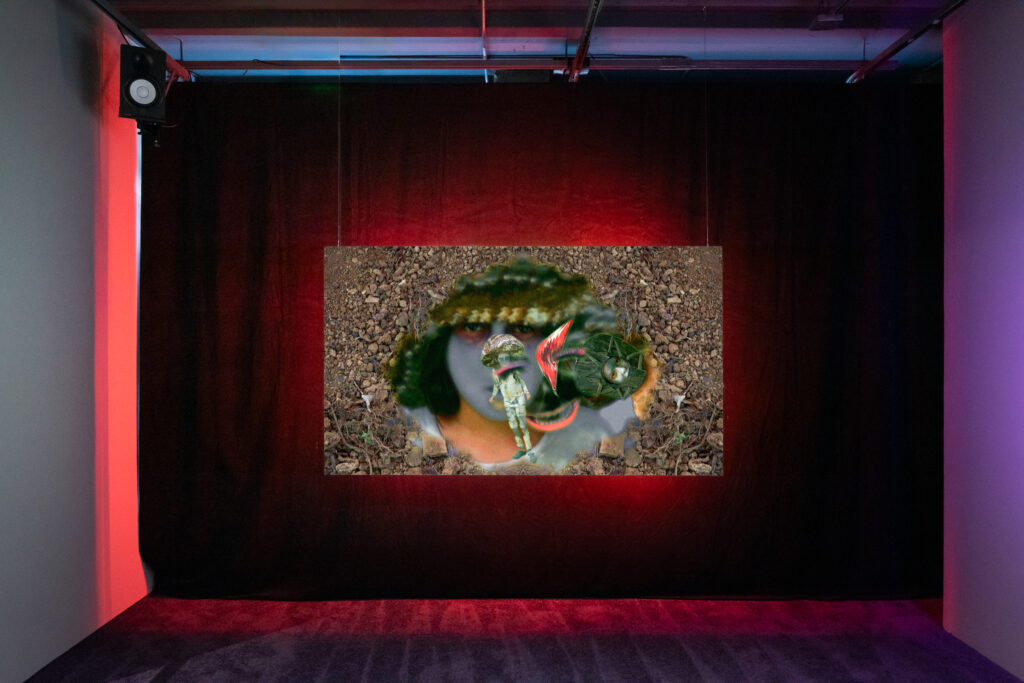
What form will the apocalypse take? And what will life be like after? Picture yourself entering a dark space dedicated to obscure cultural rituals. Within the dimly lit interior, projections of figures laugh and writhe within the endless debris of failed civilization.
You know that some form of apocalypse is coming (and has already arrived, hard and soft, in many different forms and in many different places). And you know also, somewhere deep inside at least, that things will not be the same–not just life after, and all its manifold established processes necessary for survival or culture, but also the infinite variety of social relations.
Since extreme apocalypse is perhaps as challenging to imagine as the end of capitalism (which is not unrelated, of course, to the coming apocalypse itself), perhaps we could learn a thing or two while speculating on what things look like after the collapse? Or at least enjoy ourselves imagining what future pleasures might be taken in a world we otherwise avoid thinking about.
Fervid, overflowing, semi-feral visions invoking such future possibilities were imagined and embodied by Naomi RIncón Gallardo in a set of artworks gathered and activated from May to August of 2025 under the title Convulsiones Planetarias at San Francisco’s Kadist Foundation (reportedly the last public exhibition at that space–a different kind of endtime). These works don’t attempt to heal any metabolic rift between humans and the rest of the natural world. Rather, the figures in these creative envisionings – distilled most intensely in three highly performative, musically inflected videos – occupy manifestations of that rift, camp out and revel in them, while deviating from normalized attitudes and behaviors generated by ruinous social systems.
In the three videos – whose titles Soneto de Alimañas [Sonnet of Vermin], Filiación Abono [Dung Kinship] and Resiliencia Tlacuache [Tlacuahce Resilience] suggest some of the poetics of Indigenous, punk, queer ecofeminism they are positioned within – mutant, cross-species superheroes costumed in gaudy, synthetic fur like dark cartoon avatars (mis)behave in burnt-out landscapes and trashy morgue-cum-party-room interiors with exuberant jouissance. Parties and drunken debauchery abound in their fractured narratives, as do pointers, protests, and virulent antidotes to decayed physical environments and debased social and cultural developments. These include calling out the gentrification of the Indigenous cultivation of mescal, for instance, or the commodified appropriation of Indigenous knowledge of psilocybin mushrooms and other genetic material by extractivist Euro-American capitalism.
In reaction, the videos’ characters source, concoct and consume potent mind- and behavior-altering substances as inoculation, if not cure – elucidating, enlivening and encouraging responses to shifted and scarred environments. Demonstrating a commitment to Indigenous practices but also necessary holistic realignments to the conditions of late modern industrial actualites and their byproducts, the potions are made from traditional local plants (agave, tejate and mushrooms) but also the repurposed sludge of rotting bodies and the products of toxic garbage.
Among the costumed creatures in these performances, protuberant genitalia abound: prosthetic (and real) breasts and tongues are prominent, lively, and alluring – or at least lurid. With such sensual pursuits and mind-altering activities, thus, there comes an erotic draw toward the differences embodied in decay, death and destruction and those in procreation and transmutation. Rather than turning away from the toxic wastelands we have inherited, Convulsiones Planetarias proposes we should inhabit and engage with them fully.
In doing so, we can recognize the value of creatures deemed problematic and even pestilent (as suggests Vermin Sonnet) and reclaim anti-capitalist, Indigenous Meso-American cultural praxis (as pointed to in Opossum Resilience). Dung Affiliation, meanwhile, urges us to track the connectedness of all things, even those networks of demeaned creatures who process decay, like flies and dung beetles, who do not shy away from what can be made of waste. This cultivates the notion that rather than stuff to reject, even the worst products of waste can crucially re-nurture new life, even if that life might mutate away from ideals, forms and norms previously held dear.
Neither strictly kitsch or camp, the videos’ sprawl in and out of music and film styles suggests a post-apocalyptic vaudeville – the putting on a show as part of daily life while wallowing in the decadence of consuming and getting consumed. The genre blur includes cabaret shows, low-budget science fiction movies, d-i-y music videos, ethnographic and nature documentaries, and/or horror films. Working across musical genres of punkish-folk, nueva cancion, brass band, rancheras, corridos, and the calliope vaudeville sound of fairs and fiestas reminds us of the fleshy intimations of the carnal in carnival, which inhabit and resonate within each of the videos’ figures and their actions. The fanciful costumes help perform a developing, politically resistant cos-play bursting from individual fantasies or mass culture shopping centers and trash dumps. Convulsiones Planetarias performs a cultural counterattack by remixing and reperforming queered punk versions of indigenous avatars, while making clear that there never were any “pure” or authentic archetypes.
As one instance of wild proliferation, Sonnet of Vermin (2022) begins with a closeup on a half-buried demonically amused medusoid head – or is the miasmatic sprawl of her jet-black hair actually an oil slick or some other toxic residue? To a soundtrack of gasps and groans, colorful hybrid creatures emerge – humans costumed as bat, scorpion, serpent and frog – birthed out of the contortions of the wickedly laughing head.
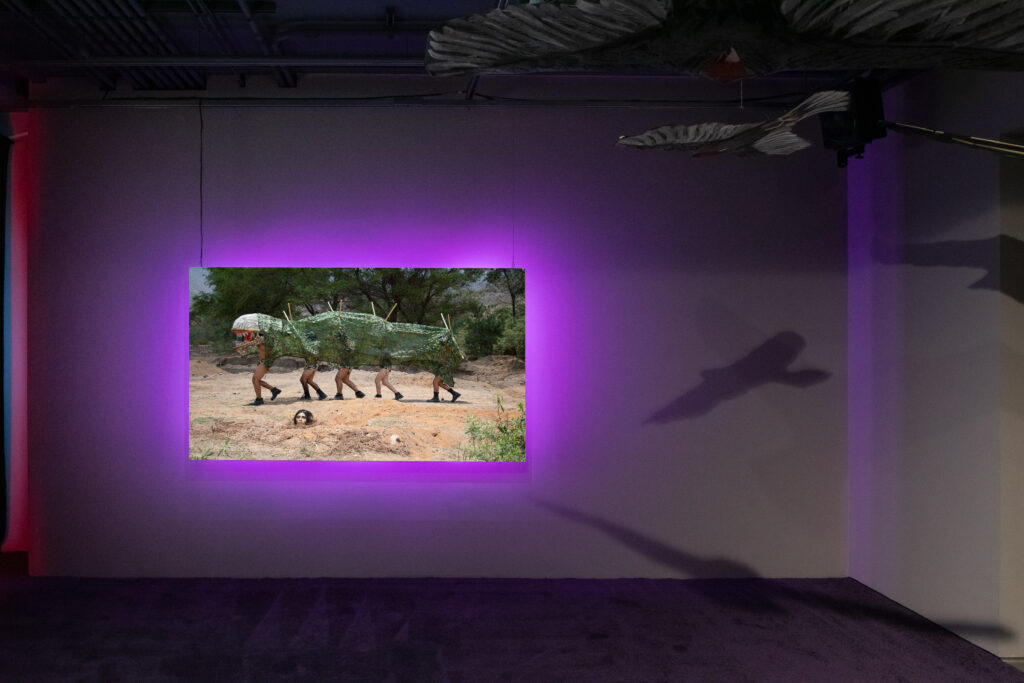
The multiple transformations of this spawning figure – credited as “Funerary Bundle,” tagging a period where she is wrapped in word-daubed cloths and a cyborgian mask made of leftover technology parts – include manifestations as oracle as well as mother. Eventually casting off the mask to confront a woven-reed, snapping alligator (representing, it seems, the depredations of capitalist extractivism), the Funerary Mother signals resurrection, the possibility of life beyond death, or becoming dead again, In the mortal encounter with toxic processes and circumstances enacted by the alligator, who delivers a verdict to the Funerary Mother: “You must be sacrificed…”
Despite relying on questionable Spanish colonial sources, Bataille's reading of Mesoamerican sacrifice contains an idea that might be apt here: that ritualized destruction of surplus life force acts like cultural compost, regenerating both literal fertility in the soil and metaphorical abundance in society by recycling surplus energy back into productive capacity. Rather than prioritizing human life as we have known it – or even humans at all – new forms of life itself, different kinds of knowledges, experiences and priorities may bloom and blossom in and among “the weeds,” those arbitrarily labeled recrudescences that challenge narrow managerial thinking by refusing to fit categories of "usefuI resource" or "waste." As others have reminded us, the transformation of waste is a central tenet of human culture (thinking of you, Patti Smith!)
The concept of transformation is key to the artworks’ trajectory as it is to life and death on the planet in general – transformation from one form to another, not only the linear, gradual path of predictable evolution but the sudden lightning bolt of intervention, of magic, of difference coalesced (see Frankenstein, Mary Wollstonecraft Shelley’s moral tale of creative re-purposing and newly charged anima, even if the sad fate of the “monster” is to die in non-life-affirming Antarctica). Transformation, then, not as a solo project, but as something that can and must and will be accomplished as a series of collaborative, carnivorous, even cannibalistic protocols.
Skipping through genres and influences, Dung Kinship (2024) starts as a sort of nature film, turns into a sci-fi horror movie, and ends up as a freakout update on the psychedelic era. This last is a grudge re-match between localized ethnopharmacology and “extraction, cultural appropriation, bioprospecting, and colonization,” to quote a recent report on "Ethical Concerns about Psilocybin Intellectual Property." The psychedelic battle references the real-life story of Oaxacan shaman/poetess María Sabina Magdalena García, mycologist and banker Gordon Wasson, and multinational corporation Sandoz bio-pharmocologist Alfred Hoffman.
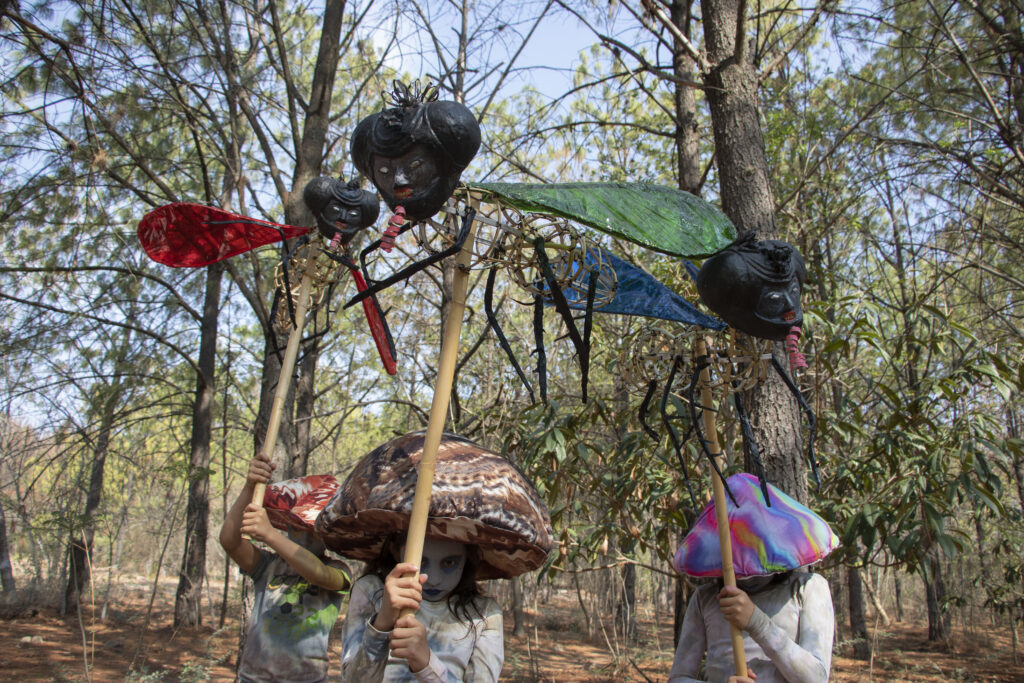
The larger tale of Dung Kinship is told through dark lenses of necrophilia or something that might be called compostophilia, shifting from the brief view of a real-life beetle pushing a ball of dung to reveal several humans costumed as flies biking into the frame from a distance to a rising techno-sounds and persistent buzzing. These figures begin digging in the earth until confronted by a band of human children with headgear and facepaint made up as lively mushrooms who chant a celebration of mycelial networks to the accompaniment of a slow brass band musical number. The plot twists with the capture of a protagonist fly, to whom the children explain its fate of death, dismemberment and decomposition on the way to larger cycles of fecund recycling.
The resistant insect ultimately succumbs to the force of Xochipilli, the Aztec god of flowers, art, music, and dance (also associated with fertility and hallucinogenic plants), and, the dead fly is violently transported underground to be processed and further initiated in the mysteries of decay and recombinant mutualism by a junk-ornamented green-faced figure with black lips credited as “The Matron of Filth and Shit”. She intones a litany about her power amid the fluid movements of generative cycles that reconstitute and connect all living things, even and because of the lowest of the low:
“I am the bastardess that feeds off filth
Shit-loving flies please me with their caresses
I am she who sprouts among filth and trash
My ferments provide inebriation and cure”
The Matron leads an underground industrial bacchanale, assisted in arcane mixology by other creatures dedicated to transforming rotting matter into elixirs of next-gen life when imbibed by the still living, almost living or waiting to be made alive–the fly’s corpse both key ingredient of the brew and reanimated beneficiary. The cognitive overtones of psychedelic experience are invoked as much as the botanical magic performed by mycelial networks. Large phallic mushrooms and serpents protrude from the costumed crotches of Xochipilli and the Matron, suggestively indicating the intensity of life always on the cusp of reconception. Back aboveground, a costumed-human dung beetle enters the scene clumsily but industriously pushing along its giant feed ball. Even the representatives of military brutality – faceless bodybuilder acrobats in camouflage underpants – end up falling to the endlessly decomposing/recompositing work performed by so-called scavengers: vultures, dung beetles and flies.
Finally, Tlacuache Resilience (2019) is the most sustained of the works in pointing to Indigenous lifeways by name. It centers around a human-opossum figure who cultivates and demonstrates the energizing qualities of mescal, pulque, and aguamiel (the opossum being a figure of regeneration in Mesoamerican mythology). The song and dance numbers in this video also contain the most specific references to localized, real-world political struggles. It pivots around a fatal 2012 attack on members of COPUVO, which opposed the mining company Cuzcatlán’s environmentally degrading initiatives in San José del Progreso and other Oaxacan Zapotec communities against those communities’ wishes. The allusions to the confrontation between collective community and corporate mining are told through a rap song – one of three differently styled musical numbers in the video. Perhaps not too much of a spoiler alert: like the assassinated members of COPUVO, the opossum becomes a figure of sacrifice as a kind of culmination.
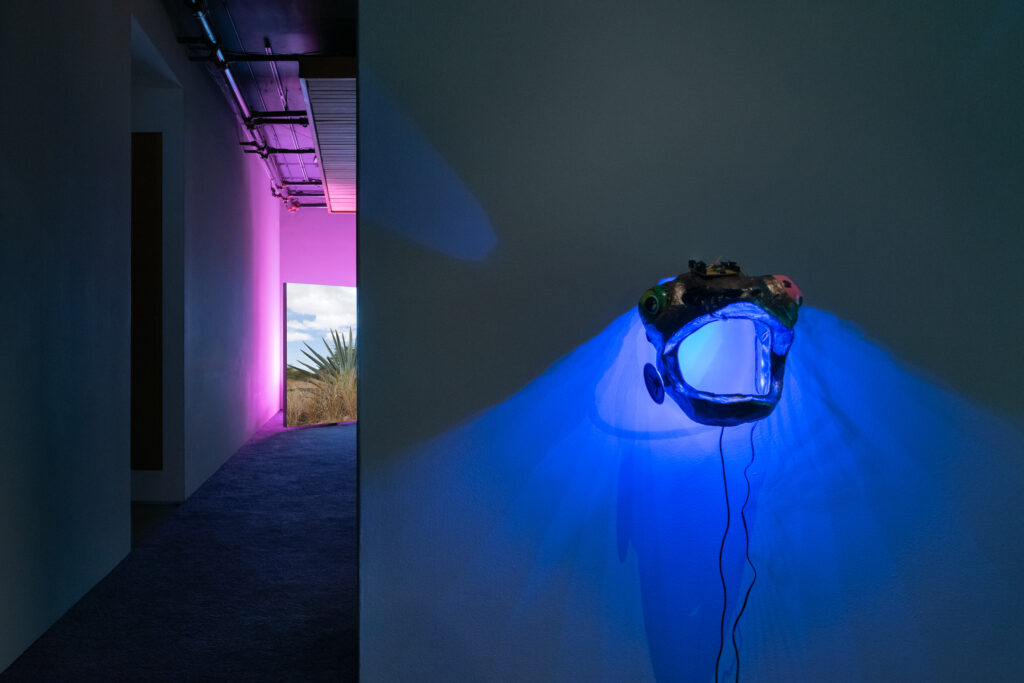
In San Francisco, the three videos were projected with audio accessible via headphones in a dark and softly inviting interior space, somewhat distantly surrounded by Rincón Gallardo’s drawings, which served as reminders of the creative process. Also present were filmic props repurposed as stand-alone sculptural forms–dung-affiliate scavenging vulture cutouts hung overhead, and vermin masks glowing in stop-and-go hues of red and green hung on nearby walls, along with the ominous physical manifestation of the enshrouded Funerary Bundle.
What does it mean that this coalescing of aggressive thinking and feeling – as embodied through a punk-ish, queer, critical, somewhat indigenously traced ecofeminist imagination and performances – is benignly offered up as a sort of high/low-cultural escape room, archived and somewhat sumptuously presented, at this point in time in San Francisco, the epicenter and incubator of escalating extractivist, hyper-capitalist tech culture? Is self-conscious “culture-making” all we’ve got as we enter an era where the oxymoronic dark enlightenment impacts life and planet? Will Convulsiones Planetarias’ own darkly joyful warning call remain on tap, however much squirreled away like other cultural repositories were sequestered in European monasteries during earlier Dark Ages?
Or has its message already begun disseminating, fermenting, and taking hold–meme-like, viral, mycelially rhizomic, turning the rot of capitalism into newly fecund petrichor for next-gen mutations in new fields of built ruins lapsing back into nature? By ingesting the worst of the poisons that have been loaded in the environment, we may be, knowingly or not, giddily or not, bearing pustulant fruits of further toxic outcomes while getting drunk on putridity.
END
What form will the apocalypse take? And what will life be like after? Picture yourself entering a dark space dedicated to obscure cultural rituals. Within the dimly lit interior, projections of figures laugh and writhe within the endless debris of failed civilization.
You know that some form of apocalypse is coming (and has already arrived, hard and soft, in many different forms and in many different places). And you know also, somewhere deep inside at least, that things will not be the same–not just life after, and all its manifold established processes necessary for survival or culture, but also the infinite variety of social relations.
Since extreme apocalypse is perhaps as challenging to imagine as the end of capitalism (which is not unrelated, of course, to the coming apocalypse itself), perhaps we could learn a thing or two while speculating on what things look like after the collapse? Or at least enjoy ourselves imagining what future pleasures might be taken in a world we otherwise avoid thinking about.
Fervid, overflowing, semi-feral visions invoking such future possibilities were imagined and embodied by Naomi RIncón Gallardo in a set of artworks gathered and activated from May to August of 2025 under the title Convulsiones Planetarias at San Francisco’s Kadist Foundation (reportedly the last public exhibition at that space–a different kind of endtime). These works don’t attempt to heal any metabolic rift between humans and the rest of the natural world. Rather, the figures in these creative envisionings – distilled most intensely in three highly performative, musically inflected videos – occupy manifestations of that rift, camp out and revel in them, while deviating from normalized attitudes and behaviors generated by ruinous social systems.
In the three videos – whose titles Soneto de Alimañas [Sonnet of Vermin], Filiación Abono [Dung Kinship] and Resiliencia Tlacuache [Tlacuahce Resilience] suggest some of the poetics of Indigenous, punk, queer ecofeminism they are positioned within – mutant, cross-species superheroes costumed in gaudy, synthetic fur like dark cartoon avatars (mis)behave in burnt-out landscapes and trashy morgue-cum-party-room interiors with exuberant jouissance. Parties and drunken debauchery abound in their fractured narratives, as do pointers, protests, and virulent antidotes to decayed physical environments and debased social and cultural developments. These include calling out the gentrification of the Indigenous cultivation of mescal, for instance, or the commodified appropriation of Indigenous knowledge of psilocybin mushrooms and other genetic material by extractivist Euro-American capitalism.
In reaction, the videos’ characters source, concoct and consume potent mind- and behavior-altering substances as inoculation, if not cure – elucidating, enlivening and encouraging responses to shifted and scarred environments. Demonstrating a commitment to Indigenous practices but also necessary holistic realignments to the conditions of late modern industrial actualites and their byproducts, the potions are made from traditional local plants (agave, tejate and mushrooms) but also the repurposed sludge of rotting bodies and the products of toxic garbage.
Among the costumed creatures in these performances, protuberant genitalia abound: prosthetic (and real) breasts and tongues are prominent, lively, and alluring – or at least lurid. With such sensual pursuits and mind-altering activities, thus, there comes an erotic draw toward the differences embodied in decay, death and destruction and those in procreation and transmutation. Rather than turning away from the toxic wastelands we have inherited, Convulsiones Planetarias proposes we should inhabit and engage with them fully.
In doing so, we can recognize the value of creatures deemed problematic and even pestilent (as suggests Vermin Sonnet) and reclaim anti-capitalist, Indigenous Meso-American cultural praxis (as pointed to in Opossum Resilience). Dung Affiliation, meanwhile, urges us to track the connectedness of all things, even those networks of demeaned creatures who process decay, like flies and dung beetles, who do not shy away from what can be made of waste. This cultivates the notion that rather than stuff to reject, even the worst products of waste can crucially re-nurture new life, even if that life might mutate away from ideals, forms and norms previously held dear.
Neither strictly kitsch or camp, the videos’ sprawl in and out of music and film styles suggests a post-apocalyptic vaudeville – the putting on a show as part of daily life while wallowing in the decadence of consuming and getting consumed. The genre blur includes cabaret shows, low-budget science fiction movies, d-i-y music videos, ethnographic and nature documentaries, and/or horror films. Working across musical genres of punkish-folk, nueva cancion, brass band, rancheras, corridos, and the calliope vaudeville sound of fairs and fiestas reminds us of the fleshy intimations of the carnal in carnival, which inhabit and resonate within each of the videos’ figures and their actions. The fanciful costumes help perform a developing, politically resistant cos-play bursting from individual fantasies or mass culture shopping centers and trash dumps. Convulsiones Planetarias performs a cultural counterattack by remixing and reperforming queered punk versions of indigenous avatars, while making clear that there never were any “pure” or authentic archetypes.
As one instance of wild proliferation, Sonnet of Vermin (2022) begins with a closeup on a half-buried demonically amused medusoid head – or is the miasmatic sprawl of her jet-black hair actually an oil slick or some other toxic residue? To a soundtrack of gasps and groans, colorful hybrid creatures emerge – humans costumed as bat, scorpion, serpent and frog – birthed out of the contortions of the wickedly laughing head.
The multiple transformations of this spawning figure – credited as “Funerary Bundle,” tagging a period where she is wrapped in word-daubed cloths and a cyborgian mask made of leftover technology parts – include manifestations as oracle as well as mother. Eventually casting off the mask to confront a woven-reed, snapping alligator (representing, it seems, the depredations of capitalist extractivism), the Funerary Mother signals resurrection, the possibility of life beyond death, or becoming dead again, In the mortal encounter with toxic processes and circumstances enacted by the alligator, who delivers a verdict to the Funerary Mother: “You must be sacrificed…”
Despite relying on questionable Spanish colonial sources, Bataille's reading of Mesoamerican sacrifice contains an idea that might be apt here: that ritualized destruction of surplus life force acts like cultural compost, regenerating both literal fertility in the soil and metaphorical abundance in society by recycling surplus energy back into productive capacity. Rather than prioritizing human life as we have known it – or even humans at all – new forms of life itself, different kinds of knowledges, experiences and priorities may bloom and blossom in and among “the weeds,” those arbitrarily labeled recrudescences that challenge narrow managerial thinking by refusing to fit categories of "usefuI resource" or "waste." As others have reminded us, the transformation of waste is a central tenet of human culture (thinking of you, Patti Smith!)
The concept of transformation is key to the artworks’ trajectory as it is to life and death on the planet in general – transformation from one form to another, not only the linear, gradual path of predictable evolution but the sudden lightning bolt of intervention, of magic, of difference coalesced (see Frankenstein, Mary Wollstonecraft Shelley’s moral tale of creative re-purposing and newly charged anima, even if the sad fate of the “monster” is to die in non-life-affirming Antarctica). Transformation, then, not as a solo project, but as something that can and must and will be accomplished as a series of collaborative, carnivorous, even cannibalistic protocols.
Skipping through genres and influences, Dung Kinship (2024) starts as a sort of nature film, turns into a sci-fi horror movie, and ends up as a freakout update on the psychedelic era. This last is a grudge re-match between localized ethnopharmacology and “extraction, cultural appropriation, bioprospecting, and colonization,” to quote a recent report on "Ethical Concerns about Psilocybin Intellectual Property." The psychedelic battle references the real-life story of Oaxacan shaman/poetess María Sabina Magdalena García, mycologist and banker Gordon Wasson, and multinational corporation Sandoz bio-pharmocologist Alfred Hoffman.
The larger tale of Dung Kinship is told through dark lenses of necrophilia or something that might be called compostophilia, shifting from the brief view of a real-life beetle pushing a ball of dung to reveal several humans costumed as flies biking into the frame from a distance to a rising techno-sounds and persistent buzzing. These figures begin digging in the earth until confronted by a band of human children with headgear and facepaint made up as lively mushrooms who chant a celebration of mycelial networks to the accompaniment of a slow brass band musical number. The plot twists with the capture of a protagonist fly, to whom the children explain its fate of death, dismemberment and decomposition on the way to larger cycles of fecund recycling.
The resistant insect ultimately succumbs to the force of Xochipilli, the Aztec god of flowers, art, music, and dance (also associated with fertility and hallucinogenic plants), and, the dead fly is violently transported underground to be processed and further initiated in the mysteries of decay and recombinant mutualism by a junk-ornamented green-faced figure with black lips credited as “The Matron of Filth and Shit”. She intones a litany about her power amid the fluid movements of generative cycles that reconstitute and connect all living things, even and because of the lowest of the low:
“I am the bastardess that feeds off filth
Shit-loving flies please me with their caresses
I am she who sprouts among filth and trash
My ferments provide inebriation and cure”
The Matron leads an underground industrial bacchanale, assisted in arcane mixology by other creatures dedicated to transforming rotting matter into elixirs of next-gen life when imbibed by the still living, almost living or waiting to be made alive–the fly’s corpse both key ingredient of the brew and reanimated beneficiary. The cognitive overtones of psychedelic experience are invoked as much as the botanical magic performed by mycelial networks. Large phallic mushrooms and serpents protrude from the costumed crotches of Xochipilli and the Matron, suggestively indicating the intensity of life always on the cusp of reconception. Back aboveground, a costumed-human dung beetle enters the scene clumsily but industriously pushing along its giant feed ball. Even the representatives of military brutality – faceless bodybuilder acrobats in camouflage underpants – end up falling to the endlessly decomposing/recompositing work performed by so-called scavengers: vultures, dung beetles and flies.
Finally, Tlacuache Resilience (2019) is the most sustained of the works in pointing to Indigenous lifeways by name. It centers around a human-opossum figure who cultivates and demonstrates the energizing qualities of mescal, pulque, and aguamiel (the opossum being a figure of regeneration in Mesoamerican mythology). The song and dance numbers in this video also contain the most specific references to localized, real-world political struggles. It pivots around a fatal 2012 attack on members of COPUVO, which opposed the mining company Cuzcatlán’s environmentally degrading initiatives in San José del Progreso and other Oaxacan Zapotec communities against those communities’ wishes. The allusions to the confrontation between collective community and corporate mining are told through a rap song – one of three differently styled musical numbers in the video. Perhaps not too much of a spoiler alert: like the assassinated members of COPUVO, the opossum becomes a figure of sacrifice as a kind of culmination.
In San Francisco, the three videos were projected with audio accessible via headphones in a dark and softly inviting interior space, somewhat distantly surrounded by Rincón Gallardo’s drawings, which served as reminders of the creative process. Also present were filmic props repurposed as stand-alone sculptural forms–dung-affiliate scavenging vulture cutouts hung overhead, and vermin masks glowing in stop-and-go hues of red and green hung on nearby walls, along with the ominous physical manifestation of the enshrouded Funerary Bundle.
What does it mean that this coalescing of aggressive thinking and feeling – as embodied through a punk-ish, queer, critical, somewhat indigenously traced ecofeminist imagination and performances – is benignly offered up as a sort of high/low-cultural escape room, archived and somewhat sumptuously presented, at this point in time in San Francisco, the epicenter and incubator of escalating extractivist, hyper-capitalist tech culture? Is self-conscious “culture-making” all we’ve got as we enter an era where the oxymoronic dark enlightenment impacts life and planet? Will Convulsiones Planetarias’ own darkly joyful warning call remain on tap, however much squirreled away like other cultural repositories were sequestered in European monasteries during earlier Dark Ages?
Or has its message already begun disseminating, fermenting, and taking hold–meme-like, viral, mycelially rhizomic, turning the rot of capitalism into newly fecund petrichor for next-gen mutations in new fields of built ruins lapsing back into nature? By ingesting the worst of the poisons that have been loaded in the environment, we may be, knowingly or not, giddily or not, bearing pustulant fruits of further toxic outcomes while getting drunk on putridity.
END


Subscribe to our newsletter!
¡Gracias por suscribirte!










CALLE DEL ARTÍCULO 123 #116 INT. 100,
COLONIA CENTRO, CUAUHTÉMOC,
CDMX 06040, MÉXICO